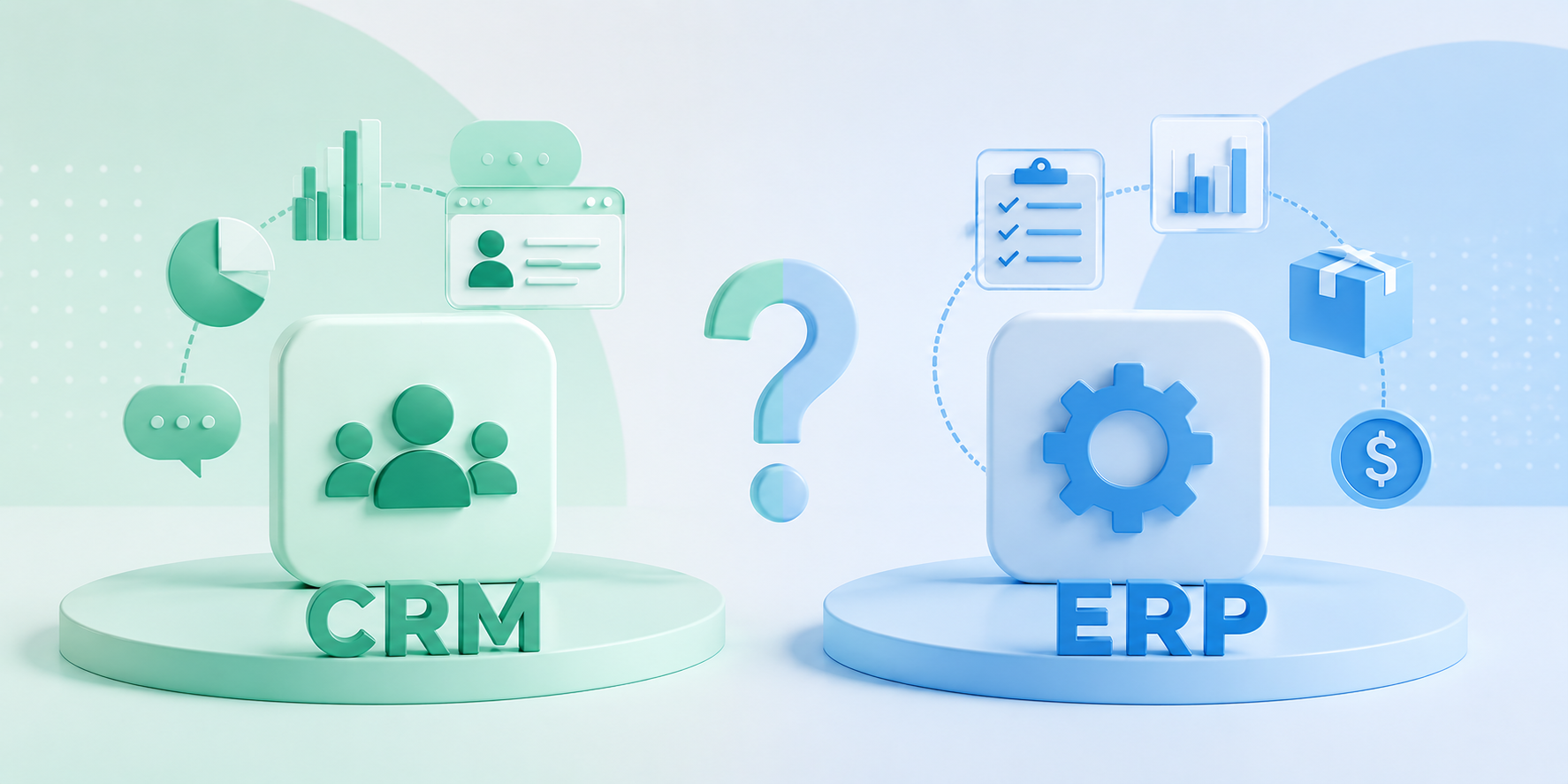

As businesses grow and their daily data and operations become more complex, they need systems that help them organise their work and manage information more efficiently. This is where CRM and ERP systems come in as two essential solutions for managing different areas of a business, with each serving a distinct purpose.
A CRM primarily focuses on customer relationships, sales, and communication, while an ERP manages a company’s resources and internal operations, including accounting, inventory, procurement, and human resources. Understanding the CRM vs ERP difference can therefore help you identify the system that best fits your business needs instead of choosing a solution that does not fully support your goals.
So, what do CRM and ERP mean? What are the key functions of each system? And does your business need a CRM, an ERP, or a combination of both? In this article, we explore the key differences between the two systems and the factors that can help you make the right choice for your business.
What Is CRM?
CRM stands for Customer Relationship Management. It is a system that helps businesses organise and manage all customer-related information and interactions in one place. A CRM system allows businesses to store customer data, track leads, record customer communications, and manage sales opportunities. This makes it easier for sales, marketing, and customer service teams to access the information they need and improve the way they interact with customers.
Therefore, a CRM is not limited to storing customer data. It also helps businesses build more organised and lasting customer relationships, improve the customer experience, and support sales growth.
Key CRM Functions for More Efficient Business Management
A CRM system offers a range of functions that help businesses organise customer relationships, improve communication, and streamline sales processes. Some of the key functions include:
- Customer Data Management: Collecting and organising customer information, contact details, and interaction history in one place, making it easier to access and use when needed.
- Lead Management: Tracking potential customers from their first interaction until they become actual customers, while organising follow-ups and sales opportunities.
- Sales Management: Organising the different stages of the sales process, tracking deals and opportunities, and helping sales teams see what has been completed and what requires follow-up.
- Customer Interaction Tracking: Recording calls, emails, meetings, and other interactions to provide a clear overview of each customer’s history with the business.
- Marketing and Follow-Up Automation: Automating repetitive marketing and follow-up tasks, such as sending messages and reminding sales teams to follow up with leads.
- Customer Service: Organising and tracking customer requests and enquiries, helping businesses provide faster and more consistent service.
- Reporting and Performance Analysis: Providing reports and data that help management measure sales performance, understand customer behaviour, and identify opportunities for improvement and growth.
Who Needs a CRM System?
A CRM system is well suited to businesses that rely on building lasting customer relationships and need to manage sales, communication, and follow-ups more efficiently. Its use is not determined by company size alone, but also by the nature of the business, the number of customers, and the operations it manages. Some of the businesses and teams that can benefit from a CRM include:
- Sales-Oriented Businesses: To track leads and deals and organise the different stages of the sales process.
- Service Businesses: To manage customer data, track requests, and maintain ongoing communication with customers.
- Marketing Teams: To better understand customers, organise marketing campaigns, and track their results.
- Customer Service Teams: To access customer interaction history and manage enquiries and requests more effectively.
- Businesses with a Large Customer Base: To keep customer data in one centralised system instead of relying on scattered spreadsheets and files.
- Businesses Looking to Increase Sales: To improve the follow-up of sales opportunities and reduce the risk of losing potential customers.
In general, if your business is dealing with a growing number of customers or struggling to organise customer data, track sales opportunities, and manage communications, a CRM system can be an important tool for improving customer relationship management and supporting business growth.
What Is ERP?
ERP stands for Enterprise Resource Planning. It is an integrated system that helps businesses manage their various operations and resources through a single platform. An ERP system brings together data and processes from different areas of a business, such as accounting and finance, inventory, procurement, human resources, sales, and supply chain management. This reduces information silos and makes it easier for departments to share data.
As a result, an ERP system gives businesses a more comprehensive view of their operations and helps them improve efficiency, reduce errors, and make more informed decisions based on unified data.
What Are the Different Types of ERP Systems?
ERP systems vary depending on the types of operations a business needs to manage. An ERP system can include a range of specialised modules that work together on a single platform. Some of the main types of ERP systems based on their functions include:
- Financial and Accounting ERP: Helps manage accounts, invoices, expenses, revenues, financial transactions, and reporting.
- Human Resources ERP: Supports employee data management, attendance and leave tracking, payroll, performance evaluations, and other HR processes.
- Inventory Management ERP: Helps track inventory levels and product movement, as well as organise storage and procurement operations.
- Procurement ERP: Makes it easier to manage suppliers, purchase orders, and related procurement and invoicing processes.
- Sales ERP: Helps organise sales orders and invoices, track sales operations, and connect them with inventory and financial data.
- Manufacturing and Production ERP: Suitable for industrial businesses, helping them plan production, manage materials, and track manufacturing processes.
- Supply Chain ERP: Helps organise procurement, transportation, and distribution operations and connect them with inventory, purchasing, and sales.
Some ERP systems combine these functions into a single system, allowing businesses to choose the modules that meet their needs and expand them as the business grows.
Who Needs an ERP System?
An ERP system is well suited to businesses with multiple operations that need to manage their resources and data through a single centralised system, especially as the business grows and the number of departments and processes increases. It can be particularly beneficial for:
- Medium and Large Businesses: Those managing large volumes of operations and data and needing to connect different departments.
- Businesses Managing Inventory and Procurement: To track product movement, orders, and suppliers in a more organised way.
- Manufacturing Businesses: To manage production processes, raw materials, and operational activities.
- Businesses with Multiple Departments or Branches: To centralise data and make it easier to share information across different parts of the business.
- Businesses That Need Integrated Financial Management: To connect financial operations with purchasing, sales, inventory, and other business processes.
- Fast-Growing Businesses: To help organise operations and scale without relying on separate systems and files.
In general, if managing daily operations requires multiple tools or separate spreadsheets, or if it has become difficult to get a unified view of the company’s performance and resources, an ERP system may be a suitable option for bringing these processes together and improving operational efficiency.
What Is the Difference Between CRM and ERP?
Although both CRM and ERP systems help businesses organise their operations and improve efficiency, they have different areas of focus. A CRM primarily focuses on customers and customer relationships, from tracking leads to managing sales and customer service. An ERP, on the other hand, focuses on a company’s internal operations and resources, such as financial management, inventory, procurement, and human resources. Therefore, the main CRM vs ERP difference lies in what each system manages and the goals it is designed to achieve.
| Comparison | ERP | CRM |
|---|---|---|
| Primary goal | Manage company resources and internal operations | Manage customer relationships and improve sales |
| Main focus | Finance, inventory, procurement, human resources, and operations | Customers, sales, and communication |
| Users | Finance, HR, procurement, operations, and other teams | Sales, marketing, and customer service teams |
| Type of data | Financial, operational, and administrative data | Customer data, interactions, and sales opportunities |
| Main benefit | Integrate processes and improve operational efficiency | Improve customer experience and sales efficiency |
| Example use | Linking a purchase to inventory and accounting | Tracking a lead and converting them into a customer |
Despite the differences between CRM and ERP, the two systems are not mutually exclusive. Businesses can use them together and connect customer and sales data with financial and operational processes. This integration provides a more comprehensive view of business performance, from the first customer interaction to completing a sale and recording it in the financial system.
CRM vs. ERP: Which One Does Your Business Need?
- Choose CRM if your main challenge is customers and sales: For example, if you struggle to track leads, organise customer data, manage sales opportunities, or improve communication and customer service.
- Choose ERP if your main challenge is internal operations: For example, if you need to manage accounting, inventory, procurement, and human resources, or improve coordination between departments.
- Choose CRM and ERP together if you need to connect both sides: Especially if your business needs to link customer and sales data with financial and operational processes in an integrated system.
Frequently Asked Questions About CRM and ERP
Below are answers to some of the most common questions that can help you understand how CRM and ERP systems are used and make a clearer decision about which system is right for your business.
1. Is CRM Part of ERP?
Not necessarily. CRM and ERP are two different systems, although some ERP systems may include customer and sales management features within their modules. If these features do not meet the company’s needs, a specialised CRM system can be used and integrated with the ERP.
2. Can You Use CRM Without ERP?
Yes, a CRM can be used independently without an ERP. This is suitable for businesses whose needs focus on customer management, sales, marketing, and customer service, and that do not currently need an integrated system to manage internal operations.
3. Can You Use ERP Without CRM?
Yes, an ERP can be used without a separate CRM, especially if the customer and sales management features it provides are sufficient for the company’s needs. However, if the business relies heavily on managing customers, sales opportunities, and customer communication, it may benefit from using a specialised CRM alongside its ERP.
4. Is CRM Suitable for Small Businesses?
Yes, a CRM can be suitable for small businesses that need to organise customer data and manage sales and sales opportunities. A business does not need to be large to benefit from a CRM; the decision mainly depends on the nature of the business and the scope of its needs.
5. Is SAP an ERP or a CRM?
SAP is primarily an ERP system, designed to manage a company’s core business processes and resources. However, SAP also offers CRM solutions for managing customer relationships, sales, and customer interactions.
Smarter Systems, Better Performance
Choosing the right system is more than a technical decision. It can shape how your business operates and grows over time. When your systems work together seamlessly, it becomes easier to access information, manage operations, and make better decisions.
At EvoKey, we help businesses build digital and technology solutions tailored to their needs, from system integration to digital solution development and technology infrastructure improvements. If you want your systems to work together more efficiently, contact our team to find and implement the right solution for your business goals.
Read also: The Importance of Custom API Integration for Business Applications
More to explore: How Can Cloud Hosting Benefit Small Businesses in Jordan?